Click for Trujillo, Honduras Forecast
Showing posts with label Trujillo. Show all posts

Monday, August 1, 2011

The Many Views From the New Balcony


Many of my Internet friends, high school friends, and relatives have asked me to show the view from the new balcony. This is just a small part of the pictures I have taken this year

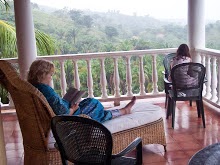
The house faces to the NE.  The balcony is U-shaped and wraps around three sides of the house.  The front part of the balcony is 10' x 58'.  From there we have a panoramic view of Trujillo Bay, the peninsula leading to Puerto Castilla, where Dole owns a facility for shipping their fruits all over the word.  It is the deepest saltwater port in the Americas.  Just beyond there we can see a little slice of the Caribbean.  


This tree is the neighbor's across the street.  Some night I am going over there with a chain saw andd cut the top out of that tree.;-D  The city is down below, but we cannot see it.

On the sides of the house the balcony is 4' x 38'.  Not very large but large enough to put chairs on, if you want to get away for a few minutes.


Here is the view from the from the west side.


;


The beginning of sunset.  You can't see it in this picture, but we can see the bay through the trees.  Not much, though, so I am considering a midnight chain saw raid here, too.

From the corridor
.
The neighbor was kind enough to leave the bougainvilla on my side of the fence.  The rest of the garden is his, but I enjoy it.


From the kitchen window

Now to the east.


Capiro, part of the Calentura-Capiro Nation Cloud Forest Park  This is the view from my bedroom window  and the corridor.  The trees in the foreground are mangoes, but not the kind I like.


From the corridor and my bedroom window.  I get teased about being able to pick mangoes from the corridor, and I can with one of those gadgets they make for picking fruit. 


And now the back portico.


Calentura with her head in the clouds.  The people say she has a headache when she looks like this.  Most of the time it means the clouds will drop down to about 2,000 feet and supply the moisture needed by the flora and fauna on the mountain.


Calentura without the the headache.  You can see how high this mountain really is.  No, I don't love this mountain. ;-0   I just like to look at it.    Because this is a national park it can't be built on or destroyed.


The leaves on the trees on our mountains don't change color in the fall, but that doesn't mean we don't have colors.  When the trees bloom they can be pink, red, orange, a pale greenish white, and even gold, like this.

We are blessed.


Monday, July 4, 2011

My Fourth of July in Trujillo

Today one of my friends asked if I had seen the American Flag flying from the old American Embassy in Trujillo..  Red-faced, I had to ask where the Old American Embassy was located.  When she told  me it was close to Johnny Glynn's store, I thought I knew where it was.  MM hauled me downtown to find it, and as we approached El Centro, there it was, The Stars and Stripes, fluttering in the breeze.  It was so good to see it, and it made me so proud of who I am.

As luck would have, the Flag was flying from the balcony of Mr.  Glynn's house.  MM has known Mr. Glynn all his life, and I met Mr. Glynn at the grand opening of the new eco-park on Guaimoreto Lagoon.  Mr. Glynn made a really big mistake at the grand opening; he told me anytime I wanted anything, let him know.  Anybody who knows me well knows I am a history buff; and Mr. Glynn is the man to see about history in Trujillo. . 

Mr. Glynn closes his store at 11:30 AM to 2 PM, so he and his employees can have lunch and a siesta.  At 2:10 PM I was in the store, talking to him.   Thank goodness, he speaks perfect English.  He is the second generation of Glynns born in New Orleans and reared in Trujillo.  He is one of the wealthiest men in Trujillo, and I really did not expect him to spend any time with me.  I was surprised when he invited me into his home and we talked about 30 minutes.

Then he gave me a wonderful surprise.  He looked for a copy of a dissertation done by Taylor E. Mack when he was working on his PhD in the Department of Geography and Anthropology at LSU.  He told me he has never let anyone take this book out of his house, and he let ME bring it home to read!  Me! a person he barely knows.  I am so honored.

So, tonight we are going to have hamburgers, potato salad and refritos for supper and watch fireworks on TV.  We are going to go to devotions with a group of young people here on a mission trip. And I am going to start reading Ephemeral Hinterlands and the Historical Geography of Trujillo, Honduras, 1525 - 1950,  A Dissertation.

I am having a wonderful Fourth of July..

We are blessed

Friday, December 10, 2010

We Are Blocked in By Angry Protesters

It has been raining  for several weeks now.  The campesinos have disrupted life in Colon while protesting  that a bridge that was washed out several weeks ago still has not been fixed.  They protest by taking over all the roads, including the back roads leading to a town, and cut off all traffic.  What causes this type of protest?  The campesinos feel, and rightly so, that this is the only way they will be heard.

Macho Man says there is  no gasoline in Trujillo.  That makes three days now and the taxistas are unable to pick up fares.  Buses cannot travel between here and Tocoa, the nearest town of any size.  It also means that no fresh produce was delivered  yesterday, so the produce market is pretty much empty.  The bread trucks cannot get through, so there is no bread.  The dairy delivery trucks......well, you get the picture.   MM just came from the market and the grocery store.  He says there is very little to be had, even rice and beans.  The citizens of Trujillo are angry.  They say the campesinos have kidnapped Trujillo and are holding her for ransom

There are semi's from Dole lined up for miles on either side of the road block.  If they are there too much longer you can expect to pay more for bananas, pineapple and other tropical fruits.  Dole uses Puerta Castilla as its biggest port in Central America, and the trucks headed this way are loaded with perishables.

The ambulance from our little hospital cannot get to Tocoa or La Ceiba and we have no ICU, orthopedic surgeons or other specialists, nor the ability to take care of trauma.  There is no CT scanner, no MRI, no NICU nor many other things you expect in a modern hospital.  There certainly is no air rescue. The government has promised in the past not to allow the campesinos to tie up the roads and take cities hostage, but the government knows this could get very ugly very quickly.  They are not doing anything right now because the Human Rights inspectors are coming tomorrow. 

Courtesy La Prensa
Campesinos blocking the road to Trujillo


Human Rights would love to report that Honduras abuses the rights of its citizens.  They will not report that soldiers and police officers are facing a large group of men armed with rifles, shotguns and machetes, along with big sticks and rocks, and have not made any type of aggressive move.

I don't know where this is going, but I hope it will be resolved peaceably.  That is not always the case. 

I will try to write about the construction and post some pictures this week end.

Please pray this will not end in bloodshed. 

We have food in the house.  We are blessed.'

Update:

This morning the Army and the National Police broke up the blockade.  It ended very peacefully, with the campesinos jusst walking away.  The government is going to set up a permanent  post at the entrance to the back road to prevent this from happening again.  That means that everyone going that way will be stopped, and if they don't like you, your car will be searched.  That's OK by me.  I would rather spend a few minutes telling the police who I am and where I live, than to have people blocking the road so that we cannot even get food into Trujillo.  The people here deserve better than that.

There was no bloodshed, so we are blessed.

Monday, September 6, 2010

Things I Have Learned From Being on Water Restrictions

I talked about water restrictions last Thursday but I really did not know just how restricted it would be for us. The water company said they would turn the water on from 6-9 AM and from 2-7 PM.  They lied!  They lied! THEY LIED!!!

The water might come on somewhere between 6 and 8 AM and it goes off at 9:20 AM.  It might come on at 3PM. and go off again in 15 minutes, and repeat that cycle until 7 PM, but you never know exactly when that 15 minutes will be. 

There is very little water pressure, so little  it can take 20 minutes to fill the tank on the toilet.  Even when the water comes on, we are on the same line as the hotel.  Of course, they get first dibs on the water, and Rufina starts washing clothes and linens; Miguel starts filling the leaky pool; and we have no water, just the sound of the water trying to push the air out of the faucet.  Saturday, they were nice enough to stop everything until we could get a shower, but, it ended up being a bucket bath with cold water.  There was not enough pressure to fill the hot water tank nor to supply the shower.

I have learned some things.  I think I said I had learned pila etiquette, which means you don't put anything in the clean water.  The clean water gets scooped up with a clean bowl and poured over whatever you are washing or rinsing.  When you are throughyou scoop up a bowl for the next person, who might need to wash his hands, because you don't want him to put his hands into the clean water.

I can now take a bucket bath in less than two minutes using less than one gallon of cold water.  The average 8 1//2 minute shower in the USA  uses 17.2 gallons of water.  Have a teenager?  Ever seen him/her take and 8 minute shower?

The average American, if he lets the water run while he brushes his teeth, wastes 2 gallons of water a day.  We have learned to fill a 20 ounce glass and both of us can brush our teeth and leave some for the next morning.

Today we had to wash a load of MM's work clothes.  It took six 5 gallon buckets of water for each cycle and MM had to carry each of those  buckets up two flights of stairs.  That is 12 buckets of  water, 60 gallons.  We hooked up to the hotel's outside faucet, because we had no water.

If you take your bath late in the afternoon, you can use the same clothes the next day.  Then you put  the shirt in the dirty clothes basket and wear the pants again the next day.  Except Macho Man.  He is allowed to change shirts twice a day and pants every day, if he has been working on the house.

Baby wipes are great for wiping down if you have no water.  They are refreshing, really, and they take off makeup better than anything else I've tried.  I like the ones with aloe the best.  They seem to moisturize the best.  And you don't feel sticky.

If you go swimming late in the afternoon, you may not be 100% clean, but you feel clean.  The hotel will let us do that.  They even told us to bathe in the pool, but I have dreams of them turning on the aerater and mountains of soapsuds flowing all over the place.

The toilet does not need to be flushed every time it is used.  Unless you like lugging 5 gallon buckets around. 

If you get up in the morning every day, and you turn on your faucet and get water, you are better off than much of the world.  If that water is clean, you are even more blessed.

The biggest problem we have is that the crew is still mixing cement, and that takes water, lots of water, and in the next two weeks, when we start pouring the terrazza we will need even more.

Imagine this, my Honduran Macho Man was carrying a bucket of water in one hand, and a Coleman lantern in the other, muttering, "There is no water.  There is no electricity.  What I am doing in Honduras?'.

http://www.allianceforwaterefficiency.org/Residential_Shower_Introduction.aspx
http://wiki.answers.com/Q/How_much_water_is_wasted_brushing_teeth

Monday, January 25, 2010

Trujillo - Markets and other places


Trujillo is a small town on the North Coast of Honduras, and as one guide book put, "Folks, Trujillo is the end of the road."  It is quite literally the end of the road on the North Coast, except for the dirt road that goes to several little Garífuna villages.  Christpher Columbus first set foot on Cental American soil at Punta Caxinas, or Cabo de Honduras August 14, 1502.  The first Catholic mass in Central America was said on that date.  The modern history of the town dates from 1524. 

Trujillo is built in the typical Spanish Colonial style, around a park, surrounded by the military, Forteleza Santa Barbara; the church, La Catedral de San Juan Bautista; and the government, now the city hall and the police station.  I can't find my picture of the church so I will have to add it later.


The Fort of Saint Barbara


The Park


The Government Buildings


This is one of the main streets in Trujillo. It goes around the park. Yup, those are cobblestones. The white building is a grocery store.


This is the produce market.  This cute little boy is working in his family's stall.  This child is so smart he can total up your purchases in his head, and make change without a cash register.  If he doesn't have the change, or a plastic bag to put your stuff in, he will run down the street toget one.  The other day I ask for tomatoes and  he wouldn't sell me the ones he had because they were no good.  Then he gave me two perfect bananas to make up for it.  When Juan went back the next day, the good tomatoes had not arrived, so he bought one anyway.   When he got home, there was a bell pepper in the bag, too.  Check out the size of those  carrots.


Hondurans love their cell phones.   The white things in bags are garlic. Those are fresh beets up by the cabbages.  There is another child in the background working with his family.  Every one is expected to pull his own weight to help the family survive

This young lady is probably about 16, but she works every day in the market.  There are two       kinds of sweet potatoes on her left side.  Just by the sweet potatoes are some brown things with  white edges showing.  That is yucca.  Juan doesn't like yucca, which is good, because I am allergic to the raw yucca.  Cabbages are a staple in the diet.  None of these vegetables are coated with wax or other preservatives.  They are not picked green and shipped to the market. 

        
This is Wal-Mart, Honduran style. These stores line every steet in El Centro. Then you have street vendors who line up along the streets under makeshift tents and sell everything from fruits and vegetables to DVDs. We can buy videos for about a dollar and a half, and some of them have not been released nation wide in the US. You find this same set-up in the larger towns, too. "Tico" is a cell phone provider. When you see that sign, it means a place you can go and 'charge' your phone. Cell phone service is not by the month, it is by the minute, which is why people send a lot of text messages. My fingers don't move fast enough


This is a street in a middle class-upper middle class neighborhood.  Yup, those are still cobblestones.


This is the street in front of two of  my sisters-in-law's homes.  This is a middle class neighborhood. 
Suyapa and Azucena have the better view. That patch of blue at the end of the street is the bay.