Click for Trujillo, Honduras Forecast

Thursday, January 30, 2014

Moradel and the Pech Indians near Trujillo


I thought I would start getting back into the habit of blogging by introducing you to the Pech Indians around Trujillo.  First, a little history.  The Pech are found in the Northeastern areas of Honduras.  They were at one time one of the larger of the indigenous people.  Today, they number less than 2,000, and live in about 9 small villages.  There have been Pech ruins found that date back to 300 CE.  They are traditionally hunter-gatherers, but they are rapidly being assimilated into the Latino culture as their hunting grounds and general habitat is being destroyed in the name of progress.

The leaders in the local village of Moradel are Doña Juana Martinez and her son, Profesor Angel Simeon Martinez.  Profesor Angel is certified to teach the Pech children in their own language, in an effort to keep the language from becoming extinct.  Doña Juana and her family are trying to keep alive the old crafts that they make from natural resources, such as gourds, grasses, flowers, etc.  She also makes medicines from local plants.  She is the village curandera and uses her medicines to provide for the village.  I can attest to the fact that some of them work better than traditional Western medicine.


Doña Juana Martinez, leader of the local Pech village, in her little souvenir shop. Behind her are some of the  crafts she and her family make.  The  bag is of a fiber made from local grasses.  It is dyed with natural colors derived from plants.  The natural color is the light ecru color.  The little bowls are made from various gourds, and are used for dishes and cups.  Just over her head is a hanging basket for storing foods, or anything else, that you want to keep critters out of.  The things made from fiber are woven together in a technique that can best be described as crocheting just using the fingers, with no crochet hook.

Pech Ángel Simeón Martínez representing his people at a conference at the Universidad Nacional Autónoma de Honduras.


The village of Moradel is hidden in the forest just off the main highway.  There is a sign at the turn-off, but it is difficult to find the village unless you know where to look.  When you get there, each family has their own little plot, and they are not easy to see from the road.  They build for privacy, and they do it well.
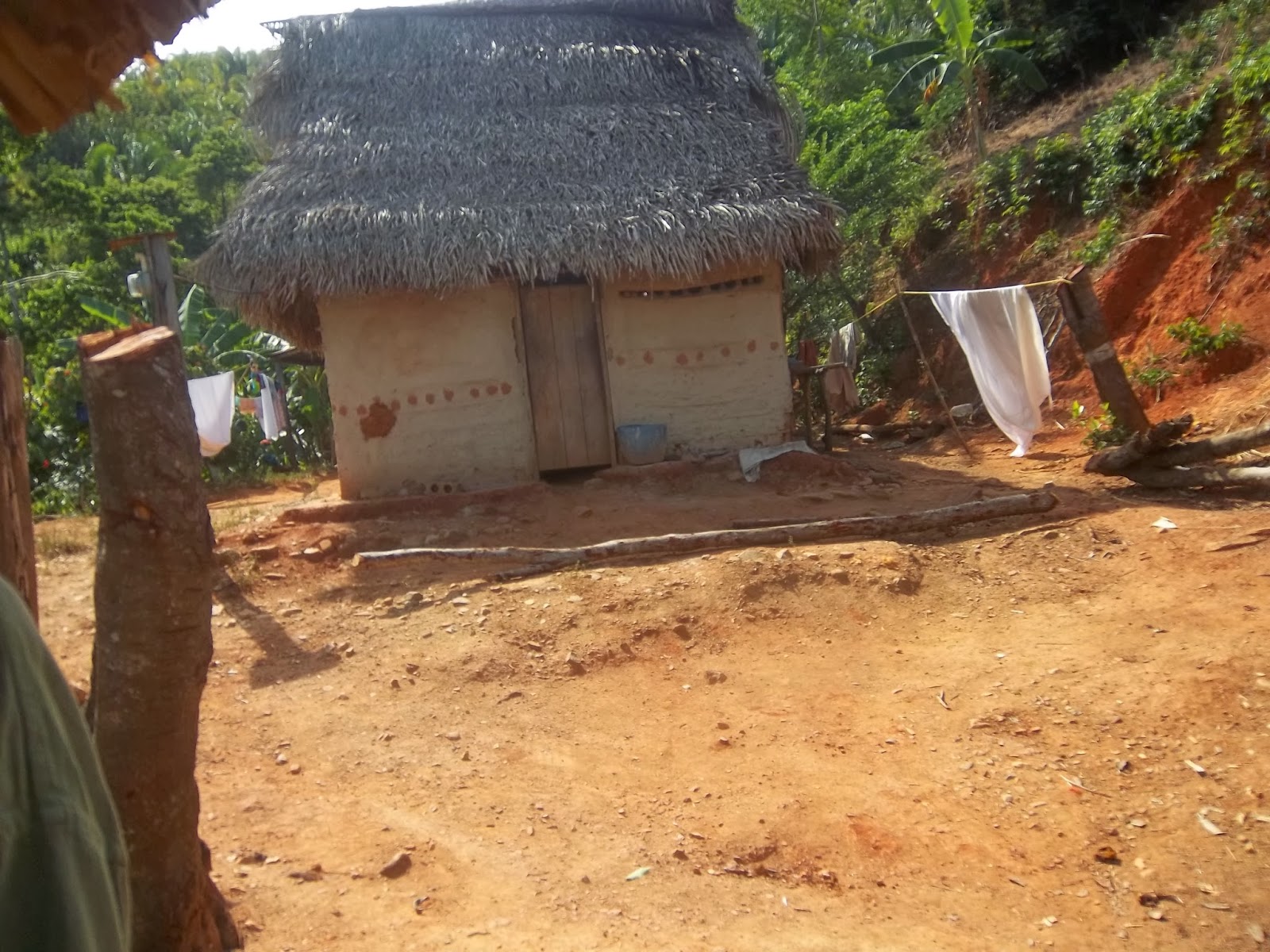
This is Doña Juan's kitchen.  It is made with clay and laced bamboo reeds.  The outside is a skim coat of mud that is smoothed by hand until it is almost silky, then whitewashed.  The roof is made of pine thatch.  Behind it is a similar structure that is the bedroom.  That building has an overhang which provides a cool place to sit, and essentially is the living room.


This is the inside of the kitchen.  The white structure is the stove, where Doña Juana cooks the family meals.  It is wood fired.  The lower part is the oven.  She is a good cook, but let me tell you, Pech food is VERY spicy. She cooked food for me when I visited one time, and my mouth was on fire for an hour. She also makes a low alcohol corn beer here. It is is so mild that even children drink it.  It is suppose to give you strength when it is hot.  It is an acquired taste.  The little woman in the door is Doña Paulina, Doña Juana's 85+ year old mother.  Eight people live here.

This is just one of the indigenous peoples in our area.  They are among the poorest, but I have never been to Moradel that I wasn't offered something to eat or drink, if only cold water served in a cup made from a gourd.

We are blessed.

Sunday, May 19, 2013

What's New in Trujillo? Part 1

I haven't written here in almost a year, and I promise to do better.  We have made a lot of progress in many ways, and we have had some setbacks.  I know it is late to be blogging about Christmas, but I need to do this in two Parts, and we had such a good Christmas Season.  so, I am making this Part 1.

 In November of 2012, Macho Man was diagnosed with Parkinson's Disease.  We have been struggling since then to   get his medications titrated, without a lot of success.   We are trying to change our diet, which is sort of difficult here at the end of the Pan Am Highway. but we are doing what we can.  Less meat and more fish and poultry, less rice and beans and more veggies and fruits.  The selection is limited here, but my produce man, Don Pedro, and his lovely wife, Doña Flor, accommodate me as much as is possible.

We have started an exercise program with a small class and a very good trainor.  We are trying to concentrate on balance and flexibility, which we both need.  Kenny, our trainer is very patient, and he has modified several of the exercises so I can do them without hurting myself.  I thing he wants me to become a weightlifter, and he tries to hang me from the rafters with exercise straps.

We got the guest room ready in time for Elisa and Victoria to use for their Christmas visit, and they loved it.  We had a wonderful Christmas here at Casa de Sueños.  The house did what it was suppose to do for the whole Season.  It welcomed everybody who came, and anyone that went away hungry or bored wanted to be hungry or bored.  

Christmas Eve we had Noche Buena on the balcony with everyone here from the youngest, Justin, to the oldest, Don Miguel.  We danced and ate and partied most of the night, then everyone went home to gear up for the next day.

One end of the table

Three of my favorite people, Elisa, Macho Man, and Victoria


Nicole, Alejandro, and Edgardo, three of the youngest


Christmas Day we cooked a whole pig. First we had to build the grill, known as a caja china Chinese box) which is essentially just that, a box made of concrete blocks set on each other without mortar. We made two grills from pieces of rebar wired together, then put the pig between them and tied them together. The charcoal went in the corners, the pig was put on top, and the fun began. The men were in charge of the cooking outside, and the women were putting together the potluck in the kitchen.
                    

Lining the china box


The beginning
  
The finished product
After dinner, we had a piñata, which people of all ages enjoyed.


From the youngest


To the not so young


To the final scramble for the candy


We spent the week between the holidays just having fun.  We spent one day at Banana Beach, one of the best beach resorts in the aare, and we have several.

My favorite man in the whole world.
GrandBrat and Papi

Macho Man on the water slide, with Victoria, Elisa, and niece, Patty, urging him on.
.
I admit, I went down the waterslide, too, but they are my pictures, it is my blog, and so the chances of you seeing them are slim.

The holidays went by too fast, but they were so blessed, and we had so much fun.  

Part 2 is forthcoming, and will bring me up to date.

We are blessed.


Thursday, July 26, 2012

Hondurans Are NOT Lazy

I still hear North Americans complain about Hondurans; about how lazy and  how unmotivated they are; and even how larcenous they are.  That has not been our experience, and those of you who read The View know this, because I have written many times how hard our helpers work

In the last ten days Joche has dug  a compost hole, laid  out a garden on each side of the portico; made  a walkway from the portico steps to the steps down to the lower level of the yard; made another walkway down to the level of the compost hole; leveled out the area around the compost hole so I don't break my neck;  and plastered the ceiling  and the walls in one of the bedrooms and the bathroom down stairs.  All this without the advantage of sophisticated machinery.


The walkways and the garden plots were dug out with a digging bar ( a big, long crowbar) and a shovel.  The ground here is very rocky because this is a mountain.  The really big rocks have to be broken up with a sledge hammer.


He mixes the cement for the plaster himself.  He has to sift the sand before the cement gets mixed to get out anything that doesn't belong, as well as remove  the small rocks that come with the sand.  The cement and the aggregate are mixed on the ground by hand and then carried to the work.  But before Joche can plaster, he must also knock small holes in the concrete blocks so the plaster  will stick to the surface.  I can assure you the wall will be perfectly smooth when I star the paint.  He finishing the ceilings with a little rougher look, just to add some texture.


Joche laying out and digging the walkway,  Note the rocks he is digging out as he goes,  The edges of the walkway are almost perfectly even and the depth is exact.


The finished walkway.  The stones have been beaten down until it is level, as Joche is well aware my balance is not what it should be.  To the left of the walkway you can see one of the garden plots that Joche leveled out and lined with rocks.  He took some of the sod from here and planted it around the bananas.  We didn't tell him to do that, but we appreciate it.


The path and handrail down to the compost hole.  The clay area around the hole is where Joche leveled the ground.  I plan to plant something there in the future,


The aggregate is thrown through this screen.  Only the fine sand can go through the screen attached to the frame.  The fine sand is mixed with the cement to make the plaster.


The sand and cement are mixed here before Joche takes it inside to use.  You can see that quite a bit of cement has been mixed in this place.


After he brings the cement in, he mixes in just the right amount of water to make a wet mixture.  That is then thrown up against the wall and smoothed out. The mix has to be just the right consistency, thrown on the wall at just the right angle, and with just the right velocity, or it won't stick.


The finished product.  This will be ready to paint in a couple of days, but we won't paint until after the floor is in.  That's next.


The bottom step made from river rocks and cement.  This helps me get up the steps with thinking I am going to lose my balance.


Joche makes L225 (about $12 USD) per day and a small bonus at the end of the week.   This is less than we used to pay, but he understands and he still comes to work when we have something for him to do, and he still does more than we ask.


This week Joche's 17 year old brother, Cristino,  has been working with Macho Man. Cristino has lined the entire perimeter of the property with rocks about 1-1/2 feet high.  The rocks were not just thrown in place, they were selected, one-by-one for the best fit.  These are heavy, granite rocks, and he has moved them by himself, with a wheelbarrow.   It helps when laying them  that the rocks are usually flat on at least one  We have about an acre of land, so this was not easy.  Yesterday Cristino dug out the holes for the foundation for the slab to hold the cistern, and today he is helping put the foundation.  Another hard job that employs moving rocks.  These young men probably dream about rocks, 'cause that is one thing we have plenty of.  ('scuse me Mr. Bragg, I know better, but the proper way to say it sounds so stuffy.)


This is the boundary marker Cristino put all the way around the property.  It comes up to the level of the first round of barbed wire.  This keeps the neighbors' chickens out of the yard; at least most of the time it does. This little wall is very stable due to the way the rocks are fitted together.


Above, Cristino is picking the rocks to form the base of the foundation for the cistern.  The pile of rocks above was about 4' high before he started moving rocks around the property.  Now it is one layer thick.


The concrete blocks are to level out the slope of the hill.  This will be filled with cement and re-leveled.  The cistern will hold 750 gallons of water,  The cistern weighs about 200 pounds, and when it is filled it will weigh approximately 6,500 pounds.  In the event city water is cut off and there is no rain, that will last us 2-1/2 to 3 weeks if we are very careful.  Since we get 144 inches rain a year, the cistern is not likely to run dry, and we will be using city water for back up.  We will only use the water from the cistern for showers, etc., because we use bottled water for consumption.


Cristino is making L 150 (about  $8 USD)  per day.  


Our guys are NOT Lazy.  They are very motivated.  And they have never taken anything from this property that was not theirs to take.


We are blessed.

Thursday, July 12, 2012

The Generosity of Southern Women

I recently posted a wish list for supplies so that the expat community  here in Trujillo could establish an Emergency Response Team.  I was overwhelmed by the response I got from the Order of Confederate Rose, Florida Society.  


Add caption


My ladies sent almost one hundred pounds of supplies which are almost non-existent in our area of Trujillo.  Things which most of you take for granted.  Things like pints of alcohol; triple antibiotic ointment; witch hazel; sterile gauze; tape, and band-aids.  Then there were the things unheard of here, like burn dressings, Adaptic (non-stick) bandages; blood pressure cuffs, and the likes.  

There were the practical things, like duct tape and magic markers; tongue blades, Popsicle sticks, hand sanitizers, tourniquets, and cotton balls; skin prep and betadine; and oh, so many other wonderful things.  The only things not there were the things I didn't think to ask for.

We were able to outfit 3 boxes of supplies with another box for backup/replacement.  This will enable us to stock three strategically placed depots, so that even if the major roads are impassable, supplies will be available.  We can cover about a 20 mile stretch of road, an area of 30+ thousand people.  


The Roses have won a spot in all our hearts, but especially in mine.  They have given voice to what I have known all my life.  There is no heart more loving and giving than that of a Southern woman.

We are Blessed

Tuesday, June 19, 2012

A New Banana Bread


One thing we do have in abundance in Honduras is bananas, and we have lots and lots of bananas.  After all, Honduras is the original Banana Republic.  The best information I can find says Honduras produces 1M metric tonnes, or a little more than 1.12 M American short tons. That's 2,204,622,622 lbs.  2.2Trillion pounds. That does not include what is produced in most yards in the country, including mine.


Now we have had our Social Studies class for the day. Shall we continue?


Today I woke up with a need to do something nice for the Macho Man, and there is nothing he likes better than banana bread.   I have to admit, I also had some bananas I needed to use, so it was an easy decision. I have become a little bored with my usual recipe for banana bread, so I decided to make it up as I went. 

It was, as the Macho Man says, a culinary adventure, but it turned out really well. The end results were rich, but not too sweet, with a nice color, moist, and tender. Best of all, because I'm lazy, there was very little clean-up, and we are on water rationing. So, here it is:


4 very ripe bananas*
2 eggs
1/3 C molasses
1/2 C peanut butter - I use chunky
1 C unbleached flour
1 C whole wheat flour
1 tsp baking soda
3 tsps baking powder
1 tsp vanilla

Preheat oven to 350.  Grease and flour a 9x5 loaf pan, line with wax paper, and grease and flour waxed paper.

Put bananas, eggs, molasses, and peanut butter to food processor and process until smooth.  Add flours, baking soda, baking powder, and vanilla and process until well-mixed and smooth.  

Pour batter into prepared pan and bake on middle rack of oven until a tooth pick stuck in the middle come out clean, about 1 hour.

Let cool in pan for 10 minutes, then transfer to rack to cool completely.  

Voila, your own banana bread, no preservatives, no unwanted additives, extra protein from the peanut butter and eggs.  Omega 3's from the peanut butter.  No added salt.  No trans-fat.

Oh yes, there is one secret ingredient.  It's called love, and no one can add that to your recipe but you.  Your family will recognize it at once.

*  Most Americans I know do not know what a ripe banana really looks or tastes like.  A truly ripe banana, the one with the best flavor, is one that is heavily freckled, almost completely brown, and soft.


We are blessed.


Thursday, May 24, 2012

ADDENDUM: What Do Expats Do Besides Lie in a Hammock


Last week I blogged on the Emergency Response Team the expats in Trujillo are forming.   Keep in mind that there is no Fire Rescue here in our area.  There was enough interest  in a list of needed supplies that I made a list and decided to post it here and on Facebook. 
Everything on the list is easily available in the US and Canada, and almost non-existent here.  Most of it is available at CVS, Walgreen's, Walmart and Target. Store brands are good.

NEEDED

Absorbent dressings, small, medium, large
Ace bandages, 2", 3", 4"
Alcohol Large bottle
     1. Alcohol in amounts of over 2-4 oz not available
Alcohol pads
Band-aids, all sizes
Benadryl
BP cuff
Burn ointment
Cervical collars, all sizes
Cotton balls, large
Cotton swabs
Duct Tape
     1. To secure victim to backboard
     2. To secure dressings in torrential rain
Eyepads, gauze
Flashlights
Fluorescent rechargeable lantern
     1. Replacement batteries not available
Hand sanitizer
Magic Markers
Pen lights
Rescue blanket, Mylar
Road flares
Rope
Rubber tourniquets
Sanitary Napkins, the old type with tails
     1. Excellent pressure dressing; does not require tape
Splints, padded if possible.
Sports tape, all sizes
Sterile gauze dressings, any size
     1. Larger amounts at lower price in Medical supply houses
Sterile gloves, all sizes, Non Latex
Stethoscope
     1. Store brand @ pharmacy good and cheaper
Tampons, small, unscented
     1. Splint for broken nose; pressure dressing for broken teeth
Tape, all sizes, non-allergenic if possible
Tongue blades/Popsicle sticks 

     1.  Splints for fingers and small children
Trauma scissors
     1. Uniform shops
Triple antibiotic salve
Walkie-Talkies
     1. Cell phone service not available in remote areas
Water-proof bags/backpacks
     1. Most disasters happen during rainy season, i.e mudslides,
         collapsed buildings, flooded rivers and streams

.
As an after thought, if you have access to medical facilities or medical training facilities, check and see if they are replacing their CPR and/or IV teaching aids/manikins.  We will gladly take the used ones.


We are not paramedics, we are just a group who want to give back to our community.  We do have nurses, doctors, dive masters and volunteers with the medical brigades in our group, and lots of people willing to learn basic First Aid.


Wednesday, May 16, 2012

What Do Expats Do Beside Lie in a Hammock?

People ask what it is we expats do, besides lie in a hammock drinking rum punch from a coconut shell dressed up with a little umbrella.   Well,  my group  in Trujillo is  organizing a totally volunteer Emergency Response Team to mobilize in case of natural or man-made disasters. We have an amazing group of medical professionals, paramedical people, and volunteers.    We have an understanding with two local doctors, who will help when needed and who will act as liaison between the patient and the various hospitals and specialists who might be needed.  We are not connected to the government in any way. 

We are doing this, in part, in self-defense. You see, there is no Fire Rescue here, and calling the police is most often an exercise in futility. 

We are  in the organization phase, but we are already putting together a list of supplies we need; we have set up a telephone tree; and one of our members is in the process of setting up a basic first aid class, a basic CPR class, and IV maintenance class.  The first aid and CPR classes are self-explanatory. The IV class is so if someone needs to be transported to another city we can send someone in the ambulance who knows how to protect the IV.  Remember, there are no paramedics in Trujillo.

So, why am I telling you this?  Well, we are not the rich expats who live in gated communities with armed guards all around.  We are more the middle-class type, or the beach bum type, with not a lot of money, but a lot of talent that can be used.   We are making our own backboards and splints.  We are learning ways to improvise supplies to which me might not have access. We are considering whether or not we can purchase at least one first responder kit (we need three).  We need other basic supplies, like ambu bags, trauma scissors, bandages and other supplies that are difficult to find here in Honduras, but are discarded everyday in ERs everywhere.

To that end, dear readers, I am asking that those of you who have contacts within the medical field or in the business of medical supply, please ask around or ask if there is anything usable you can donate.  If so, let me know, and I will make the arrangements for shipping.   On your next visit to CVS, Walgreen's,  or Walmart, if you see something on sale, like the store brand of NeoSporin, burn gel, absorbent bandages,  sanitary pads, tampons, disposable diapers, etc.,  buy a package or two, and  help us get started.

Other things we do:  We volunteer with medical and dental brigades; we teach in the local private schools; we teach English; we mentor children.  And, some of us also find time to lie in a hammock with a cold drink and a good book, and soak up God's beauty.

We are blessed.
.