Click for Trujillo, Honduras Forecast
Showing posts with label Honduras. Show all posts

Saturday, October 22, 2011

Just What Does a Cold Front Mean?


Yesterday when I got up, it was cold..  Well, it was cold for us, about 70 F. with a WCF of about 60 F.  I was going to write something fluffy, like about how I could wear one of my bulky sweaters, which I did.  About how I was wearing sock and shoes and not flip flops, which was true. About putting an afghan on the bed and letting Chico sleep with us, which we did.  Then I got serious and decided to write about a cold front means in Central America.


A cold front combined with a tropical depression, combined with the rainy season in Central America means rain, lots and lots of rain.  It has been raining for 8 days, and is suppose to continue over the weekend.  One community in Honduras reported 36" of rain in 24 hours.  That is roughly a quarter of the normal rainfall for the year on the North Coast falling in one day.  Here in Trujillo we had a tourist who died yesterday when a flash flood hit the car she was in, washing her out to sea.  Her body was found today on the other side of the bay near the port.

The Rio Cristales (Crystal River) is normally a fairly benign river.  It is where most of our water come from.  A couple of weeks ago we crossing the river and noted it was almost dried up, explaining why we had no water pressure.   This was Rio Cristales yesterday

                                                           Courtesy Trujillo Noticias
                                                         Courtesy Trujillo Noticias
If you remember, last year the main bridge between Trujillo and the rest of the world was washed away.  It just reopened  last month.  Puente La Burra spans the Rio Aguan and in  normal times it looks like this.


                                                         Courtesy Trujillo Noticias
Yesterday it looked like this.


                                                          Courtesy Trujillo Noticias


The Mayor of Trujillo was out yesterday surveying the situation at La Burra, and this is what he found.  The road leading up to the bridge apparently was not built on an adequate substrata, and is washing away.  Remember this was just opened last month.


                                                         Courtesy Trujillo Noticias
                                                          Courtesy Trujillo Noticias

In the rest of the country a cold front/tropical depression looks like this:

                                                            Courtesy La Prensa HN
A family's home is destroyed.

                                                                                         Courtesy La Prensa HN

A road falls into a ravine, cutting off the countryside from food and other supplies.  These people will have to walk pig trails to get to work, school, or just to buy food.

                                                            Courtesy La Prensa HN
Communities are cut off with bridges washed away, and who knows when this bridge will be replaced.

                                                                                          Courtesy El Heraldo HN
An official from COPECO, the Honduran equivalent of FEMA, on horseback assessing the damage in an area in southern Honduras.  The man in the canoe is delivering potable water, food and baby diapers.  

                                                            Courtesy La Prensa HN
Unlike FEMA, COPECO uses whatever works to get food and other supplies to victims in a timely manner.

Another tropical depression is waiting off the coast to move in when this one leaves.

How were we directly affected?


The bodega is flooded, and the boxes are leaning precariously as the ones on the bottom get soaked.  We will have to repack, but that's okay, because we can use this opportunity to get rid of some stuff we don't really need and check for termite damage.


The rain keeps falling and is so loud at times we can't hear the TV, or each other.


There is no view from the balcony, or at least not the usual view.  That should be the sun shining off the bay.

We have a dry, warm place to sleep.  We have clean food and potable water.  We have electricity for now.  Chico thinks he is in heaven, because he can get on the bed, something that is usually a big no-no.

We are blessed!


Monday, August 1, 2011

The Many Views From the New Balcony


Many of my Internet friends, high school friends, and relatives have asked me to show the view from the new balcony. This is just a small part of the pictures I have taken this year

The house faces to the NE.  The balcony is U-shaped and wraps around three sides of the house.  The front part of the balcony is 10' x 58'.  From there we have a panoramic view of Trujillo Bay, the peninsula leading to Puerto Castilla, where Dole owns a facility for shipping their fruits all over the word.  It is the deepest saltwater port in the Americas.  Just beyond there we can see a little slice of the Caribbean.  


This tree is the neighbor's across the street.  Some night I am going over there with a chain saw andd cut the top out of that tree.;-D  The city is down below, but we cannot see it.

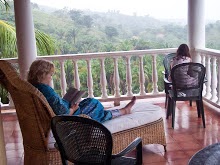
On the sides of the house the balcony is 4' x 38'.  Not very large but large enough to put chairs on, if you want to get away for a few minutes.


Here is the view from the from the west side.


;


The beginning of sunset.  You can't see it in this picture, but we can see the bay through the trees.  Not much, though, so I am considering a midnight chain saw raid here, too.

From the corridor
.
The neighbor was kind enough to leave the bougainvilla on my side of the fence.  The rest of the garden is his, but I enjoy it.


From the kitchen window

Now to the east.


Capiro, part of the Calentura-Capiro Nation Cloud Forest Park  This is the view from my bedroom window  and the corridor.  The trees in the foreground are mangoes, but not the kind I like.


From the corridor and my bedroom window.  I get teased about being able to pick mangoes from the corridor, and I can with one of those gadgets they make for picking fruit. 


And now the back portico.


Calentura with her head in the clouds.  The people say she has a headache when she looks like this.  Most of the time it means the clouds will drop down to about 2,000 feet and supply the moisture needed by the flora and fauna on the mountain.


Calentura without the the headache.  You can see how high this mountain really is.  No, I don't love this mountain. ;-0   I just like to look at it.    Because this is a national park it can't be built on or destroyed.


The leaves on the trees on our mountains don't change color in the fall, but that doesn't mean we don't have colors.  When the trees bloom they can be pink, red, orange, a pale greenish white, and even gold, like this.

We are blessed.


Friday, December 10, 2010

We Are Blocked in By Angry Protesters

It has been raining  for several weeks now.  The campesinos have disrupted life in Colon while protesting  that a bridge that was washed out several weeks ago still has not been fixed.  They protest by taking over all the roads, including the back roads leading to a town, and cut off all traffic.  What causes this type of protest?  The campesinos feel, and rightly so, that this is the only way they will be heard.

Macho Man says there is  no gasoline in Trujillo.  That makes three days now and the taxistas are unable to pick up fares.  Buses cannot travel between here and Tocoa, the nearest town of any size.  It also means that no fresh produce was delivered  yesterday, so the produce market is pretty much empty.  The bread trucks cannot get through, so there is no bread.  The dairy delivery trucks......well, you get the picture.   MM just came from the market and the grocery store.  He says there is very little to be had, even rice and beans.  The citizens of Trujillo are angry.  They say the campesinos have kidnapped Trujillo and are holding her for ransom

There are semi's from Dole lined up for miles on either side of the road block.  If they are there too much longer you can expect to pay more for bananas, pineapple and other tropical fruits.  Dole uses Puerta Castilla as its biggest port in Central America, and the trucks headed this way are loaded with perishables.

The ambulance from our little hospital cannot get to Tocoa or La Ceiba and we have no ICU, orthopedic surgeons or other specialists, nor the ability to take care of trauma.  There is no CT scanner, no MRI, no NICU nor many other things you expect in a modern hospital.  There certainly is no air rescue. The government has promised in the past not to allow the campesinos to tie up the roads and take cities hostage, but the government knows this could get very ugly very quickly.  They are not doing anything right now because the Human Rights inspectors are coming tomorrow. 

Courtesy La Prensa
Campesinos blocking the road to Trujillo


Human Rights would love to report that Honduras abuses the rights of its citizens.  They will not report that soldiers and police officers are facing a large group of men armed with rifles, shotguns and machetes, along with big sticks and rocks, and have not made any type of aggressive move.

I don't know where this is going, but I hope it will be resolved peaceably.  That is not always the case. 

I will try to write about the construction and post some pictures this week end.

Please pray this will not end in bloodshed. 

We have food in the house.  We are blessed.'

Update:

This morning the Army and the National Police broke up the blockade.  It ended very peacefully, with the campesinos jusst walking away.  The government is going to set up a permanent  post at the entrance to the back road to prevent this from happening again.  That means that everyone going that way will be stopped, and if they don't like you, your car will be searched.  That's OK by me.  I would rather spend a few minutes telling the police who I am and where I live, than to have people blocking the road so that we cannot even get food into Trujillo.  The people here deserve better than that.

There was no bloodshed, so we are blessed.

Monday, September 6, 2010

Things I Have Learned From Being on Water Restrictions

I talked about water restrictions last Thursday but I really did not know just how restricted it would be for us. The water company said they would turn the water on from 6-9 AM and from 2-7 PM.  They lied!  They lied! THEY LIED!!!

The water might come on somewhere between 6 and 8 AM and it goes off at 9:20 AM.  It might come on at 3PM. and go off again in 15 minutes, and repeat that cycle until 7 PM, but you never know exactly when that 15 minutes will be. 

There is very little water pressure, so little  it can take 20 minutes to fill the tank on the toilet.  Even when the water comes on, we are on the same line as the hotel.  Of course, they get first dibs on the water, and Rufina starts washing clothes and linens; Miguel starts filling the leaky pool; and we have no water, just the sound of the water trying to push the air out of the faucet.  Saturday, they were nice enough to stop everything until we could get a shower, but, it ended up being a bucket bath with cold water.  There was not enough pressure to fill the hot water tank nor to supply the shower.

I have learned some things.  I think I said I had learned pila etiquette, which means you don't put anything in the clean water.  The clean water gets scooped up with a clean bowl and poured over whatever you are washing or rinsing.  When you are throughyou scoop up a bowl for the next person, who might need to wash his hands, because you don't want him to put his hands into the clean water.

I can now take a bucket bath in less than two minutes using less than one gallon of cold water.  The average 8 1//2 minute shower in the USA  uses 17.2 gallons of water.  Have a teenager?  Ever seen him/her take and 8 minute shower?

The average American, if he lets the water run while he brushes his teeth, wastes 2 gallons of water a day.  We have learned to fill a 20 ounce glass and both of us can brush our teeth and leave some for the next morning.

Today we had to wash a load of MM's work clothes.  It took six 5 gallon buckets of water for each cycle and MM had to carry each of those  buckets up two flights of stairs.  That is 12 buckets of  water, 60 gallons.  We hooked up to the hotel's outside faucet, because we had no water.

If you take your bath late in the afternoon, you can use the same clothes the next day.  Then you put  the shirt in the dirty clothes basket and wear the pants again the next day.  Except Macho Man.  He is allowed to change shirts twice a day and pants every day, if he has been working on the house.

Baby wipes are great for wiping down if you have no water.  They are refreshing, really, and they take off makeup better than anything else I've tried.  I like the ones with aloe the best.  They seem to moisturize the best.  And you don't feel sticky.

If you go swimming late in the afternoon, you may not be 100% clean, but you feel clean.  The hotel will let us do that.  They even told us to bathe in the pool, but I have dreams of them turning on the aerater and mountains of soapsuds flowing all over the place.

The toilet does not need to be flushed every time it is used.  Unless you like lugging 5 gallon buckets around. 

If you get up in the morning every day, and you turn on your faucet and get water, you are better off than much of the world.  If that water is clean, you are even more blessed.

The biggest problem we have is that the crew is still mixing cement, and that takes water, lots of water, and in the next two weeks, when we start pouring the terrazza we will need even more.

Imagine this, my Honduran Macho Man was carrying a bucket of water in one hand, and a Coleman lantern in the other, muttering, "There is no water.  There is no electricity.  What I am doing in Honduras?'.

http://www.allianceforwaterefficiency.org/Residential_Shower_Introduction.aspx
http://wiki.answers.com/Q/How_much_water_is_wasted_brushing_teeth

Thursday, August 19, 2010

Building the Dream - Continued

If the placement of the pictures look funny, don't blame me.  I have been trying to post this for four days, and Blogger will not let me arrange the pictures the way I want them arranged.  They changed something right in the middle of me doing this

We are getting closer and closer to being able to start the second floor.  The window and door openings  on the first floor are  done and you can really see what the front of the house is going to look like.

The rebar in the foreground will become
part of the columns on the veranda.
This is an arch for the veranda.  There will be
five or six of these, I don't remember, across
the front.  They form part of the support for
the balcony


Remember that big mound of red clay?  Well, it is gone now.  Marvin has been busy with his shovel and has leveled it out to the height of the retaining wall.  Now you can see where the portico will be on the back side of the house.  The portico will be about 12 feet wide and 7 feet deep.  There will be two steps up from the drive to the portico, then one step up into the house.  The portico will cover the back door on the first floor becausee it spans the area between the house and the retaining wall.  I call this area the most; sometimes the ditch


     This is where the portico will be.


Marvin leveled this with a shovel.
Probably a ton of dirt, moved by
hand!


Did someone say OSHA? 
Not in Honduras;-)


Now some pictures of why this place will be so perfect when we finally get moved in.  I call them the view from the balcony.


See That little patch of darker blue by the tower in the left middle?
That is the Caribbean, and we will really be able to see it
when the balcony is finished.


All these pictures were taken on one night from the balcony of our condo


I am so looking forward to sitting on my balcony whenever I want, especially at sunset.  I don't need  Key West. 

We are blessed.

Tuesday, March 23, 2010

Two Sides of Honduras

This is Honduras, or at least the Honduras that the developers, real estate investors, and tourist guides want you to see.  It is beautiful.  I love it. It is the only thing you will see if you only go to the resorts or to the gated, gringo compounds.


Honduras is a country of marked differences, from the tropic heat of the North Coast to the moderate and sometimes cold Western Mountains. We have sunsets that are some of the most beautiful in the world...Sorry Key West, but it is true.  We have some  of the best diving you will ever do off the Bay Islands and Los Cayos Cochinos, better even than the Caymans in my opinion. 

                    You can live in a metropolitan area, and have almost all the amenities you find in the US.  You can live in one of the old colonial towns which are very picturesque, and show the influence of Spain.  You can even live among
ancient Mayan ruins dating to 900 B.C.


This is where I live.  This is considered upper middle class housing-upscale housing.   We have what is listed as a third bedroom and bath.  It is actually the maid's quarters. 


This is my Sister-in- law's house.  This is middle class housing.
She lives here with a daughter, and sometimes another daughter and a grandchild.


This is subsidized housing.  These little houses are two and three bedroom with electricity, water and plumbing.  They cost $10 - $15K USD.  The Honduran Government backs the loan.  It must be paid off in ten years.  This is how many Hondurans are able to buy their own home.


This is my neighbor's house up the mountain.  Can't find him?  I made it easy for you.  It is that little brown blob right in the middle of the picture.  This house is probably somewhere around 10' x 12' and has a thatched roof.  It is made of mud packed into interlaced tree branches, bamboo, or whatever can be used for lathing.  It is a casa de tierra, a house of earth. There is no running water and no electricity, no plumbing.  The kitchen is outside, and probably only consists of a fuego, which is like a BBQ pit covered with  piece of sheet metal and it is wood-fired; and a pila, which is a concrete sink with two sides.  One side holds the clean water, and the other is dirty.  The clean water is carried from a nearby creek in buckets.  You never allow anything dirty to contaminate the clean water.  If there is a pila, the lady of the house uses it to wash dishes, clothes, and children.  If there is no pila, she goes to the creek and beats the clothes on the rocks to get them clean.

Then there is this.  A small village of this.   Many small villages of this.  Again, no water, no electricity, no indoor plumbing.  No outhouse, just a latrine.  These are probably squatters, because Honduran law allows squatters to take land that has not been used for any purpose over a number of years.  The  casa de tierra is actually the better deal, because it does keep out the rain and some of the heat and cold.  There are actually families living here,  The Honduran government says a family is three adults and two children.  Most families are much larger.  This is the reason the Castro/Chavez Socialism/Communism model can easily take hold of a country, by promising to take land from the rich and give it to the people living in places like this.  The countries who profess to be democratic, especially those in the Western Hemisphere, need to take action, or the wolf will be at the door.

Honduras is a country of approximately 8,000,000 people.  The median age is 20.3, but most of the population is well below that. According to the CIA World Fact Book about 36% are un-or underemployed,  nearly 60% of the population lives in poverty. and of those employed, only 20% are employed in industry.  The rest are almost evenly split between agriculture and services.  We have a very young population ready to come into the job market, and virtually no jobs.

https://www.cia.gov/library/publications/the-world-factbook/geos/ho.html

The minimum wage, after is was raised 61% last year, is L5,500 ($290.70) per month.  Many people work for less because they have to, some because one whole area of the country was exempt from the raise.  The canasta basica, the basic grocery cart,  contains contains 30 items.  As of 2008 it costs L4,309 ($324 USD), and it has gone up since the increase in the minimum wage, and the recent political turmoil.

So, what can be done to change this?  I believe the answer is in education.  The school system here is deplorable.  Children are not taught to think logically and strategically.  Last year, the children only went to school 100 days, due to a teacher's strike.  The teachers strike for just about any reason, and the only ones to suffer are the children.

As expatriates, we cannot change the system.  What Macho Man and I have decided to do is mentor a child.  This child is a family member.  We will see that he gets an education.  We will probably do some home schooling.  He wants to learn English, so he can talk to me, but that may be because I buy him chocolates.  ;-D  We will try to make sure he learns to make his own decisions, not based on propaganda, but on facts he can document for himself.

I am blessed.  I am very rich compared to most Hondurans.  I have potable water, electricity most of the time, enough to eat, and a roof over my head.  If I am not my brother's keeper, I am at least his helper.  I keep remembering, "Even as you do for the least of these my brethren."  I don't believe it is optional.