Click for Trujillo, Honduras Forecast

Saturday, May 24, 2014

An Unfortunate Show of Force

I am fortunate enough to live an idyllic life in a beautiful country in Central America.  I am ever mindful that I am a guest in this country, and that I could be asked to leave at any time.  I rarely ever criticize the government here.  I frequently tell you how safe I feel with the military/police presence.  But this time, I just cannot keep my mouth shut.

We have had some civil unrest here in Trujillo over the last week between the residents of a small village, Castilla, and the combined forces of the National Police and the Honduran Army.  Castilla is a small Garifuna village just outside Puerta Castilla, the deepest deep water port in the Americas.  

The Garifuna are Black Caribs.   They are the descendants of Africans who escaped slavery and the indigenous Indians.   They depend on the land to grow food, and they are primarily fishermen.  They have their own language and their own culture.  They hold all land as community tribal land, and it cannot be sold to outsiders without the approval of all the villagers. They are also second or third class citizens, and they are frequently taken advantage of.

About five years ago, the Government decided to expand Puerta Castilla.  They made a deal with the Garifuna that included 250 new homes for the villagers, parks, and other improvements in exchange for the land.  The Port got expanded, but the homes, parks, etc., well, the village is still waiting, and not the first spade of dirt has been turned over.

This past week, after years of not being listened to, to being ignored, the Garifuna decided on a course of action, including civil disobedience, and they blockaded the port.   On Wednesday there was a confrontation that lasted about 2 hours, it ended without injuries, even though there was some tear gas involved.

The National Police and some  of the leaders of the demonstration

We demand that the government repair Highway CA 13.  We demand it pays for potable water.

The blockade
On Thursday the Port Authority, the Mayor of Trujillo, the Senator from Trujillo, the leader of Castilla and a committee of community leaders met at the Port to discuss solutions to the problem.   Apparently, the Garifuna did not accept the solution, or maybe they just didn't believe the Committee was going to do anything, because .....


The Committee

On Friday, all hell broke loose...


Note  He is not firing at the barricade, he is firing into the village

You can see the tear gas

Some of the victims were elderly

Some were babies

Most  were innocent bystanders.

Some took to the water with their children


All photos are courtesy of Trujillo Noticias, Marvin

There were no winners here.


Thursday, February 20, 2014

One of the Joys of Living in the Third World...Or Not.

Life in the Third World is always an adventure.  Every day is different.  You never know what even the next hour will bring.  The Honduran government recently passed a law requiring the two cellphone/wireless/internet providers to block all signals within one km of any prison.   Since they have not been able to control the possession of cell phones and computers within the prison walls, they decided to block access.  Their intentions were good; the results have been a disaster.

There are twenty-five prisons in Honduras, and they are miserable places.  Except for the gang lords and the narcotraficantes.  They live a life of comparative luxury, and they continue to run their organizations from behind the prison walls.  Not hard to do if you have a smart phone or computor.  The government decided to block all signals going in and coming out of the prisons.  The result has been no service for anyone in the twenty-five towns near the prisons.  Except for TV and radio, they have been held incommunicado since February 10th. 

We were promised the problem would be fixed by midnight of the 14th.  Not so.  Then the government said it would be fixed by Monday, the 16th, or TIGO and Claro (the only two providers) would pay a fine of L 2,000,000 (approx. $100,000 USD) per day until they are up and running.  On Tuesday, the 17th, the government extended the deadline for two additional WEEKS.   Now, the government officials can be seen wringing their hands every day on the news, but not doing much else; and TIGO and Claro stand mute.  Can you imagine what a field day the First World conspiracy theorists would have with this?

So, what does this mean?  It means that business has almost come to a standstill.  We cannot call for emergency help.  Banking choices are limited, unless you go to the next town.  We drove 15 miles Sunday to call our daughter and wish her Happy Birthday and to reassure her we are okay.  I saw people actually talking rather than texting.  That's notable because even the adults here are in love with texting.   Macho Man and his brother are in total withdrawal, because they are used to talking to each other several times a day, and Pablo lives in Tocoa, so we can't go to visit.  I am suffering greatly because I can't get to FB, or play Criminal Cash, Candy Crush, Wors of Wonder, or do the Washington Post crossword puzzle.  I miss my FB friends, even those who insult my intelligence on a daily basis.

When will we be reconnected to the rest of the world?  Quien Sabe? Could be before the two weeks are up, or not.  This is Honduras.

We are still blessed.

Thursday, January 30, 2014

Moradel and the Pech Indians near Trujillo


I thought I would start getting back into the habit of blogging by introducing you to the Pech Indians around Trujillo.  First, a little history.  The Pech are found in the Northeastern areas of Honduras.  They were at one time one of the larger of the indigenous people.  Today, they number less than 2,000, and live in about 9 small villages.  There have been Pech ruins found that date back to 300 CE.  They are traditionally hunter-gatherers, but they are rapidly being assimilated into the Latino culture as their hunting grounds and general habitat is being destroyed in the name of progress.

The leaders in the local village of Moradel are Doña Juana Martinez and her son, Profesor Angel Simeon Martinez.  Profesor Angel is certified to teach the Pech children in their own language, in an effort to keep the language from becoming extinct.  Doña Juana and her family are trying to keep alive the old crafts that they make from natural resources, such as gourds, grasses, flowers, etc.  She also makes medicines from local plants.  She is the village curandera and uses her medicines to provide for the village.  I can attest to the fact that some of them work better than traditional Western medicine.


Doña Juana Martinez, leader of the local Pech village, in her little souvenir shop. Behind her are some of the  crafts she and her family make.  The  bag is of a fiber made from local grasses.  It is dyed with natural colors derived from plants.  The natural color is the light ecru color.  The little bowls are made from various gourds, and are used for dishes and cups.  Just over her head is a hanging basket for storing foods, or anything else, that you want to keep critters out of.  The things made from fiber are woven together in a technique that can best be described as crocheting just using the fingers, with no crochet hook.

Pech Ángel Simeón Martínez representing his people at a conference at the Universidad Nacional Autónoma de Honduras.


The village of Moradel is hidden in the forest just off the main highway.  There is a sign at the turn-off, but it is difficult to find the village unless you know where to look.  When you get there, each family has their own little plot, and they are not easy to see from the road.  They build for privacy, and they do it well.

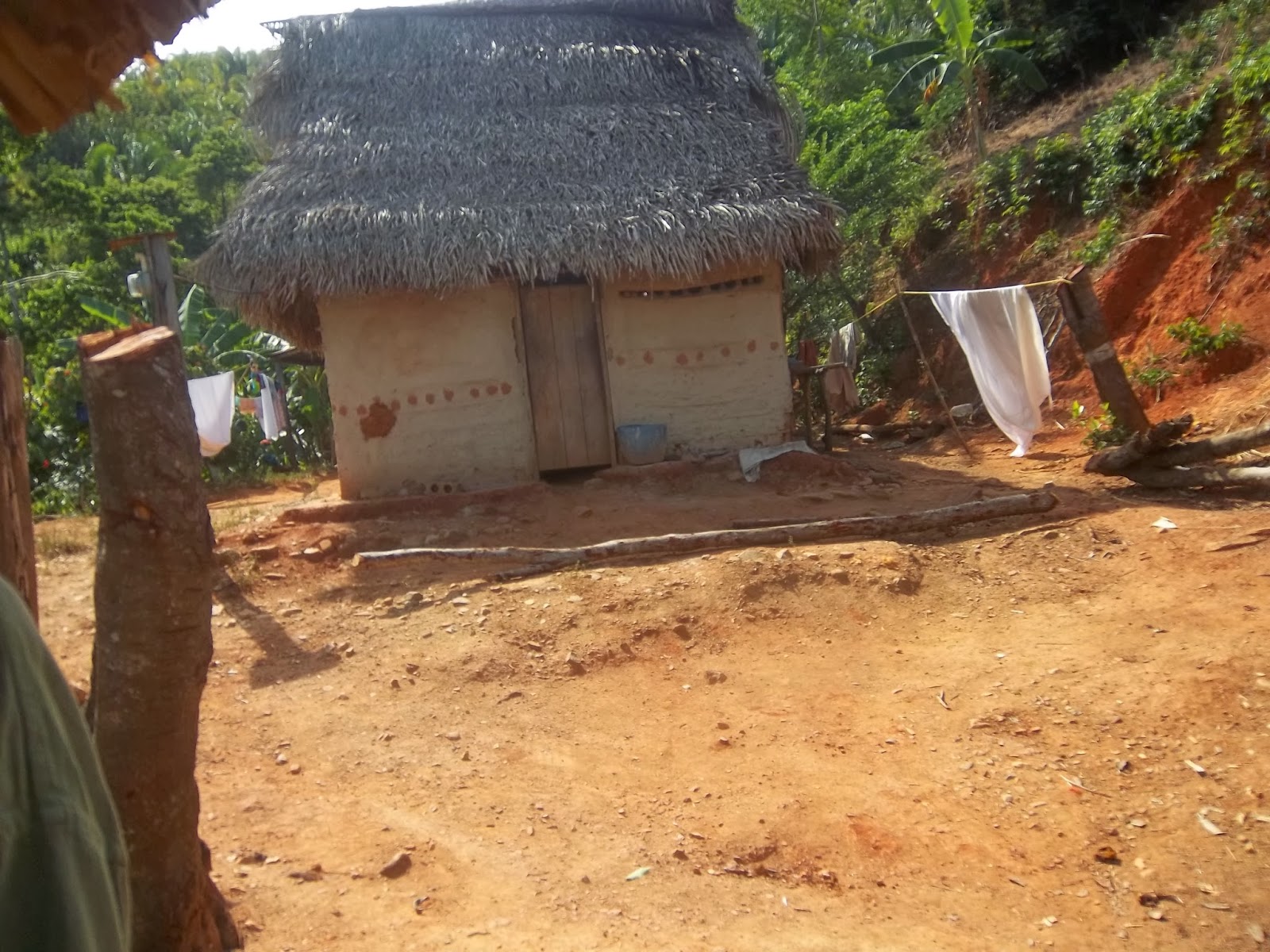
This is Doña Juan's kitchen.  It is made with clay and laced bamboo reeds.  The outside is a skim coat of mud that is smoothed by hand until it is almost silky, then whitewashed.  The roof is made of pine thatch.  Behind it is a similar structure that is the bedroom.  That building has an overhang which provides a cool place to sit, and essentially is the living room.


This is the inside of the kitchen.  The white structure is the stove, where Doña Juana cooks the family meals.  It is wood fired.  The lower part is the oven.  She is a good cook, but let me tell you, Pech food is VERY spicy. She cooked food for me when I visited one time, and my mouth was on fire for an hour. She also makes a low alcohol corn beer here. It is is so mild that even children drink it.  It is suppose to give you strength when it is hot.  It is an acquired taste.  The little woman in the door is Doña Paulina, Doña Juana's 85+ year old mother.  Eight people live here.

This is just one of the indigenous peoples in our area.  They are among the poorest, but I have never been to Moradel that I wasn't offered something to eat or drink, if only cold water served in a cup made from a gourd.

We are blessed.

Sunday, May 19, 2013

What's New in Trujillo? Part 1

I haven't written here in almost a year, and I promise to do better.  We have made a lot of progress in many ways, and we have had some setbacks.  I know it is late to be blogging about Christmas, but I need to do this in two Parts, and we had such a good Christmas Season.  so, I am making this Part 1.

 In November of 2012, Macho Man was diagnosed with Parkinson's Disease.  We have been struggling since then to   get his medications titrated, without a lot of success.   We are trying to change our diet, which is sort of difficult here at the end of the Pan Am Highway. but we are doing what we can.  Less meat and more fish and poultry, less rice and beans and more veggies and fruits.  The selection is limited here, but my produce man, Don Pedro, and his lovely wife, Doña Flor, accommodate me as much as is possible.

We have started an exercise program with a small class and a very good trainor.  We are trying to concentrate on balance and flexibility, which we both need.  Kenny, our trainer is very patient, and he has modified several of the exercises so I can do them without hurting myself.  I thing he wants me to become a weightlifter, and he tries to hang me from the rafters with exercise straps.

We got the guest room ready in time for Elisa and Victoria to use for their Christmas visit, and they loved it.  We had a wonderful Christmas here at Casa de Sueños.  The house did what it was suppose to do for the whole Season.  It welcomed everybody who came, and anyone that went away hungry or bored wanted to be hungry or bored.  

Christmas Eve we had Noche Buena on the balcony with everyone here from the youngest, Justin, to the oldest, Don Miguel.  We danced and ate and partied most of the night, then everyone went home to gear up for the next day.

One end of the table

Three of my favorite people, Elisa, Macho Man, and Victoria


Nicole, Alejandro, and Edgardo, three of the youngest


Christmas Day we cooked a whole pig. First we had to build the grill, known as a caja china Chinese box) which is essentially just that, a box made of concrete blocks set on each other without mortar. We made two grills from pieces of rebar wired together, then put the pig between them and tied them together. The charcoal went in the corners, the pig was put on top, and the fun began. The men were in charge of the cooking outside, and the women were putting together the potluck in the kitchen.
                    

Lining the china box


The beginning
  
The finished product
After dinner, we had a piñata, which people of all ages enjoyed.


From the youngest


To the not so young


To the final scramble for the candy


We spent the week between the holidays just having fun.  We spent one day at Banana Beach, one of the best beach resorts in the aare, and we have several.

My favorite man in the whole world.
GrandBrat and Papi

Macho Man on the water slide, with Victoria, Elisa, and niece, Patty, urging him on.
.
I admit, I went down the waterslide, too, but they are my pictures, it is my blog, and so the chances of you seeing them are slim.

The holidays went by too fast, but they were so blessed, and we had so much fun.  

Part 2 is forthcoming, and will bring me up to date.

We are blessed.


Thursday, July 26, 2012

Hondurans Are NOT Lazy

I still hear North Americans complain about Hondurans; about how lazy and  how unmotivated they are; and even how larcenous they are.  That has not been our experience, and those of you who read The View know this, because I have written many times how hard our helpers work

In the last ten days Joche has dug  a compost hole, laid  out a garden on each side of the portico; made  a walkway from the portico steps to the steps down to the lower level of the yard; made another walkway down to the level of the compost hole; leveled out the area around the compost hole so I don't break my neck;  and plastered the ceiling  and the walls in one of the bedrooms and the bathroom down stairs.  All this without the advantage of sophisticated machinery.


The walkways and the garden plots were dug out with a digging bar ( a big, long crowbar) and a shovel.  The ground here is very rocky because this is a mountain.  The really big rocks have to be broken up with a sledge hammer.


He mixes the cement for the plaster himself.  He has to sift the sand before the cement gets mixed to get out anything that doesn't belong, as well as remove  the small rocks that come with the sand.  The cement and the aggregate are mixed on the ground by hand and then carried to the work.  But before Joche can plaster, he must also knock small holes in the concrete blocks so the plaster  will stick to the surface.  I can assure you the wall will be perfectly smooth when I star the paint.  He finishing the ceilings with a little rougher look, just to add some texture.


Joche laying out and digging the walkway,  Note the rocks he is digging out as he goes,  The edges of the walkway are almost perfectly even and the depth is exact.


The finished walkway.  The stones have been beaten down until it is level, as Joche is well aware my balance is not what it should be.  To the left of the walkway you can see one of the garden plots that Joche leveled out and lined with rocks.  He took some of the sod from here and planted it around the bananas.  We didn't tell him to do that, but we appreciate it.


The path and handrail down to the compost hole.  The clay area around the hole is where Joche leveled the ground.  I plan to plant something there in the future,


The aggregate is thrown through this screen.  Only the fine sand can go through the screen attached to the frame.  The fine sand is mixed with the cement to make the plaster.


The sand and cement are mixed here before Joche takes it inside to use.  You can see that quite a bit of cement has been mixed in this place.


After he brings the cement in, he mixes in just the right amount of water to make a wet mixture.  That is then thrown up against the wall and smoothed out. The mix has to be just the right consistency, thrown on the wall at just the right angle, and with just the right velocity, or it won't stick.


The finished product.  This will be ready to paint in a couple of days, but we won't paint until after the floor is in.  That's next.


The bottom step made from river rocks and cement.  This helps me get up the steps with thinking I am going to lose my balance.


Joche makes L225 (about $12 USD) per day and a small bonus at the end of the week.   This is less than we used to pay, but he understands and he still comes to work when we have something for him to do, and he still does more than we ask.


This week Joche's 17 year old brother, Cristino,  has been working with Macho Man. Cristino has lined the entire perimeter of the property with rocks about 1-1/2 feet high.  The rocks were not just thrown in place, they were selected, one-by-one for the best fit.  These are heavy, granite rocks, and he has moved them by himself, with a wheelbarrow.   It helps when laying them  that the rocks are usually flat on at least one  We have about an acre of land, so this was not easy.  Yesterday Cristino dug out the holes for the foundation for the slab to hold the cistern, and today he is helping put the foundation.  Another hard job that employs moving rocks.  These young men probably dream about rocks, 'cause that is one thing we have plenty of.  ('scuse me Mr. Bragg, I know better, but the proper way to say it sounds so stuffy.)


This is the boundary marker Cristino put all the way around the property.  It comes up to the level of the first round of barbed wire.  This keeps the neighbors' chickens out of the yard; at least most of the time it does. This little wall is very stable due to the way the rocks are fitted together.


Above, Cristino is picking the rocks to form the base of the foundation for the cistern.  The pile of rocks above was about 4' high before he started moving rocks around the property.  Now it is one layer thick.


The concrete blocks are to level out the slope of the hill.  This will be filled with cement and re-leveled.  The cistern will hold 750 gallons of water,  The cistern weighs about 200 pounds, and when it is filled it will weigh approximately 6,500 pounds.  In the event city water is cut off and there is no rain, that will last us 2-1/2 to 3 weeks if we are very careful.  Since we get 144 inches rain a year, the cistern is not likely to run dry, and we will be using city water for back up.  We will only use the water from the cistern for showers, etc., because we use bottled water for consumption.


Cristino is making L 150 (about  $8 USD)  per day.  


Our guys are NOT Lazy.  They are very motivated.  And they have never taken anything from this property that was not theirs to take.


We are blessed.

Thursday, July 12, 2012

The Generosity of Southern Women

I recently posted a wish list for supplies so that the expat community  here in Trujillo could establish an Emergency Response Team.  I was overwhelmed by the response I got from the Order of Confederate Rose, Florida Society.  


Add caption


My ladies sent almost one hundred pounds of supplies which are almost non-existent in our area of Trujillo.  Things which most of you take for granted.  Things like pints of alcohol; triple antibiotic ointment; witch hazel; sterile gauze; tape, and band-aids.  Then there were the things unheard of here, like burn dressings, Adaptic (non-stick) bandages; blood pressure cuffs, and the likes.  

There were the practical things, like duct tape and magic markers; tongue blades, Popsicle sticks, hand sanitizers, tourniquets, and cotton balls; skin prep and betadine; and oh, so many other wonderful things.  The only things not there were the things I didn't think to ask for.

We were able to outfit 3 boxes of supplies with another box for backup/replacement.  This will enable us to stock three strategically placed depots, so that even if the major roads are impassable, supplies will be available.  We can cover about a 20 mile stretch of road, an area of 30+ thousand people.  


The Roses have won a spot in all our hearts, but especially in mine.  They have given voice to what I have known all my life.  There is no heart more loving and giving than that of a Southern woman.

We are Blessed